




More about Science of Forces and Magnets
In our workshop, you can gravitate toward the principles of forces and magnetism. You will experience the various interactions of attraction and repulsion between objects and discover how an object can be guided at a distance without direct contact.
What are magnets?
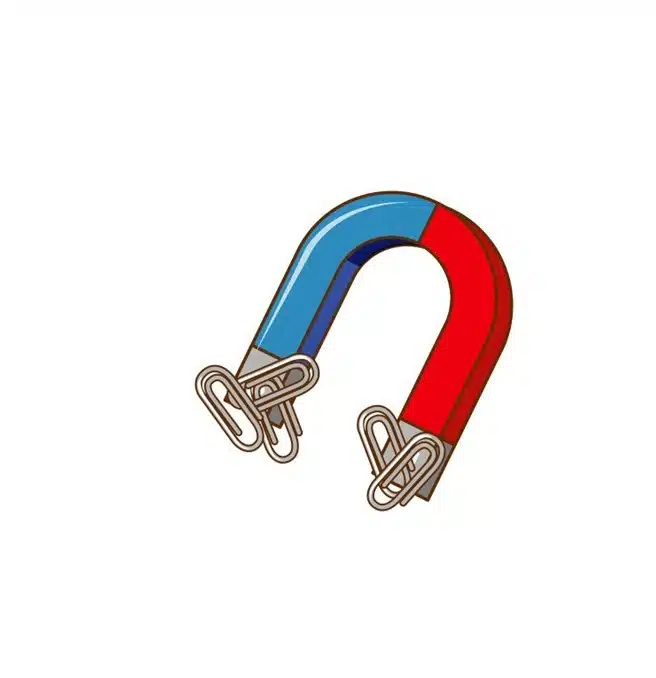
Magnets are metals that are attracted to other metals. While every magnet is classed as a metal, it is essential to note that not all metals have magnetic properties. These materials have various everyday uses in life, such as securing doors and the moving of heavy items, in addition to providing an element of fun.
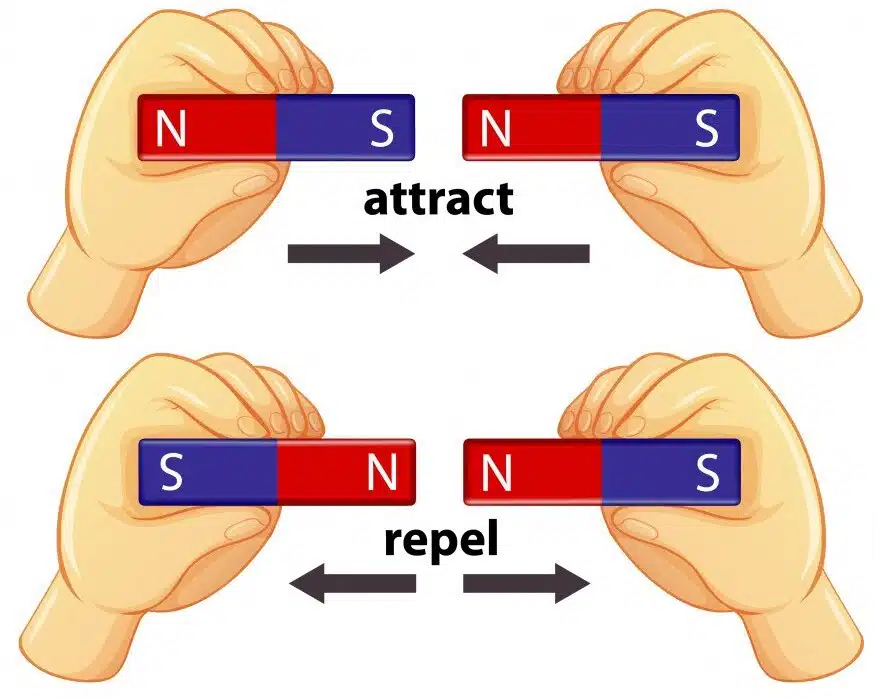
Magnets have two different ends, referred to as the north pole and the south pole.
When two poles of the same type are brought together, they repel one another. On the other hand, when two different poles are near each other, they display an attractive force.
Magnets can attract or repel each other without direct contact. The space around them has attracting and repelling forces. They are strongest at the poles of the magnet.
Repel or Attract:
Let’s test attraction and repulsion! Provide the group with magnets so they can see it in action themselves. Then, they can test what will happen and what it feels like when the same poles repel and opposite poles attract.
Who has heard the saying ‘opposites attract’? Well, this is where it comes from.
Is it Magnetic?
What materials are magnetic? Let’s find out!
We will provide the class with different objects and have them predict whether they are magnetic. Along the way, we will ask multiple questions, such as ‘What happened?’ and ‘Why?’
Newtons Cradle:
Who is Isaac Newton?
Isaac Newton was one of the greatest scientists in history. His ideas about motion and gravity are very important to the science of physics.
Newton's cradle is an intriguing device that demonstrates the transfer of energy through a series of hanging balls. When one ball is pulled back and released, it collides with the ball next to it, which impacts the next one in line, creating a continuous chain reaction. This process results in the ball on the opposite end swinging upward nearly to the same height as the initial ball, illustrating the principles of momentum and energy conservation.
We get children to test this and try and explain why or how this is happening.
Balloon Car:
Time to race! Testing out force in a fun way with a bit of competition.
To create a balloon-powered car, first attach a balloon to the car . Place the straw at the opening of the balloon, ensuring it is securely fastened. Inflate the balloon to your desired size, preventing any air from escaping until the race is ready to start. "Ready, Set, Go!" At that moment, release the straws and observe the distance and speed at which your balloon car travels.
Did the bigger or smaller balloons move faster or further?
What is the age range for Science of Forces and Magnets?
We recommend this topic for older children. It is more complex and might be harder for younger children to understand.
Download our Activity sheet:
👉 Click here for a free download of the Science of Forces and Magnet Activity Sheet
Recommended Session Duration & Ages:
Our Science of Forces & Magnets Workshop is recommended for children ages 6 and up, as the concepts can be quite confusing for younger kids. However, younger children are still welcome to participate, and we can adapt the workshop to suit their needs.
We suggest session lengths of 45 minutes to 1.5 hours, but we are happy to extend the duration if you wish to explore topics in more depth. Additionally, we offer full-day options comprising six 1-hour sessions, ideal for students of all ages.