



Magnet experiments for kids are a simple way to explore magnetism with everyday objects. You only need a few magnets and some things from around the house. Kids explore which materials are magnetic, feel magnets attract and repel, and even make a compass. They are great fun and need very little set-up.
These ideas suit home and the classroom, and they work as quick science projects with magnets. They fit the KS2 topic on forces and magnets. Preschoolers can join in too, with a grown-up and large bar magnets. Like all good science experiments, they let children predict, test and explain. Read the safety tips first, then pick the experiments that suit your group.
How Do Magnets Work for Kids? A Simple Explanation
A magnet is an object that can pull some things towards it. It has two ends, called the north pole and the south pole. Opposite poles pull together, and like poles push apart. A magnet also has an invisible magnetic field around it. Magnets attract iron and steel, but they do not attract plastic, wood or glass.
Safety First: Magnet Tips for Adults
Magnets are safe when used with care. Adult supervision is important for every experiment. Follow these simple rules.
- Supervise young children at all times. Small magnets can be a choking risk, and swallowed magnets are dangerous.
- Choose bar magnets or large magnets for little hands. Avoid very strong magnets, because they can pinch fingers.
- Keep magnets away from children who still put things in their mouths.
- Let an adult handle needles and iron filings.
What You Need for Magnet Experiments
Most of these magnet experiments use the same simple kit. You do not need to buy much.
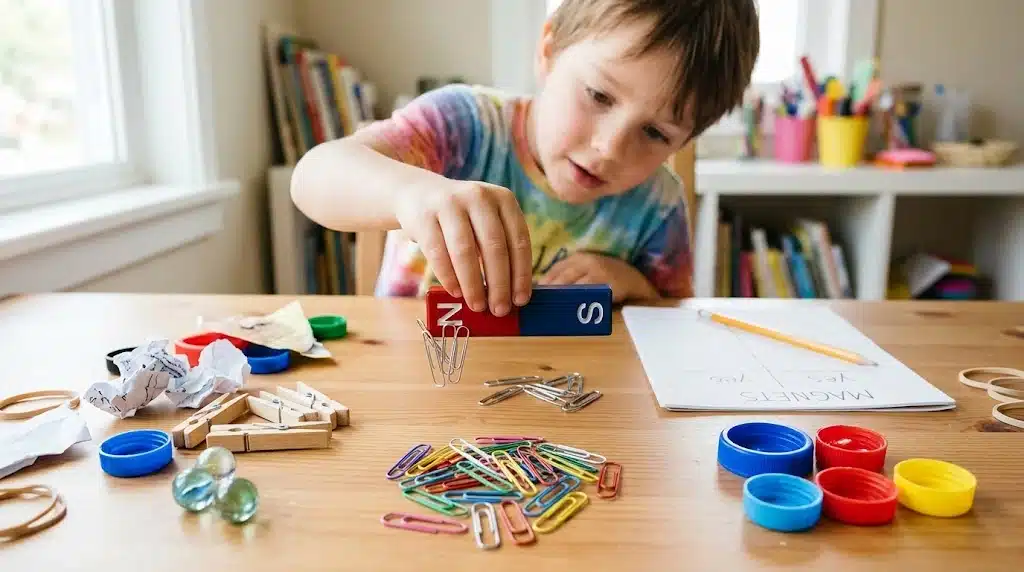
- Two bar magnets, or a few small magnets (different types work well)
- Paper clips and a few other small metal objects
- A tray or paper plate
- Everyday objects to test, such as a plastic lid, a wooden peg, a glass marble and a piece of foil
- String, glue or tape, and a pencil
1. Magnetic or Non-Magnetic? A Sorting Test
This is the classic starting point. It shows which materials are magnetic and which are not.
What to do:
- Make a pile of small metal objects and other items. Include paper clips, a steel nail, a plastic lid, a wooden peg and some foil.
- Ask your child to guess which objects the magnet will pick up.
- Hold a magnet close to each object. Sort them into two piles: magnetic and non-magnetic. Learn from any surprises.
The science: Magnets attract iron, steel, nickel and cobalt, because these metals have magnetic properties. Steel is a metal made mostly of iron, so a steel paper clip is magnetic. Not all metals are magnetic. Aluminium foil and copper wire do not stick to a magnet. Plastic, wood, glass and paper are not magnetic either, and neither are gold and silver.
2. Make a Magnet Wand and Go Magnetic Fishing
A magnet wand turns the sorting test into a game.
What to do:
- Cut fish shapes from paper and clip a paper clip to each one.
- Tie a string to a pencil or stick. Tape a magnet to the end of the string.
- Spread the fish on the floor. Lower the wand and see how many fish you can catch.
The science: The magnet pulls each paper clip towards it. This pull is a magnetic force. It works across a small gap, so the magnet does not need to touch the clip.
3. Can Magnetic Force Work Through a Plate?
This experiment tests whether a magnet can pull through other materials.
What to do:
- Put a paper clip on a paper plate.
- Hold a magnet under the plate and move it slowly.
- Watch the paper clip follow. Now try a plastic plate, a sheet of card and a stack of paper.
The science: Magnetic force passes through thin non-magnetic materials. It gets weaker as the distance grows. If the clip stops moving, the plate is too thick or the magnet is too weak.
4. Do Magnets Attract or Repel?
Here children feel the push and pull of two magnets for themselves.
What to do:
- Find the north pole and south pole of each bar magnet. Many are marked red and blue, or N and S.
- Bring two ends close together. Describe what you feel. Do the magnets pull together or push apart?
- Flip one magnet around and try again.
The science: Every magnet has a north pole and a south pole. Opposite poles attract. Like poles repel, which means they push apart. Children can feel magnetic force for themselves, so the science makes sense. Ask them to explain what they notice using the words attract and repel. This is magnetism at work.
5. Where Is a Magnet Strongest?
This experiment shows that a magnet is not equally strong everywhere.
What to do:
- Lay a bar magnet on a tray of paper clips.
- Lift it up slowly and look at where the clips cling.
- Count how many clips hang from each part of the magnet.
The science: Most clips gather at the two ends of the magnet. These two ends are the poles, where the magnet pulls most strongly. The middle pulls much less.
6. Make a Magnet Float
Ring magnets can seem to float in the air. It looks like magic.
What to do:
- Stand a pencil upright in a lump of modelling clay.
- Slide a ring magnet down the pencil.
- Add a second ring magnet. If it floats above the first, you have the right way round. If it sticks, flip it over.
The science: The two magnets face each other with like poles. They repel, so the top magnet floats on the push of the magnet below. Gravity pulls it down and the magnetic force pushes it up.
7. See a Magnetic Field With Iron Filings
You cannot see a magnetic field, but iron filings can show its shape.
What to do:
- Place a bar magnet on the table and cover it with a sheet of paper.
- An adult sprinkles a thin layer of iron filings on the paper.
- Tap the paper gently and watch the pattern appear. Draw what you see.
The science: A magnet creates a magnetic field around itself. This is the space where its force acts. The filings line up along the field lines, curving from one pole to the other. Keep filings away from faces and eyes, and tip them back into a pot afterwards. Kids can learn to draw field lines from the pattern.
8. Make a Simple Magnetic Compass
A magnetic compass points north because of the Earth's magnetic field. You can make a basic one at home.
What to do:
- An adult strokes a steel sewing needle along one end of a bar magnet. Always stroke in the same direction, about thirty times.
- Push the needle through a thin slice of cork or foam.
- Float it on still water in a bowl. Wait for it to settle, then check it against a real compass.
The science: Stroking the needle makes it a weak magnet. It lines up with the Earth's magnetic field, like a compass needle. The Earth acts like a giant magnet. Its field also helps to create the northern lights near the poles.
9. Push a Toy Car With Magnets
Use repelling poles to move a car without touching it.
What to do:
- Tape a bar magnet to the top of a small toy car.
- Hold a second magnet behind it so the two like poles face each other.
- Move the second magnet closer and watch the car roll away along a card track. Flip the magnet to pull the car back.
The science: Like poles push apart and opposite poles pull together. The car shows both a push and a pull force. Try a fair test. Measure how far the car travels with different magnets.
Quick Guide to Magnetic and Non-Magnetic Things
Children often ask what magnets attract. Here is a simple guide to magnetic objects and magnetic items around the home.
Magnetic: paper clips, steel nails, steel screws, steel cans and many tools. These magnetic materials all contain iron, steel, nickel or cobalt.
Non-magnetic: plastic toys, wood, glass, paper, rubber bands, aluminium foil and copper wire. These non-magnetic materials do not stick to a magnet.
Some objects surprise people. Tin cans are made of steel, so they are magnetic. Coins vary, so test them rather than guess.
Where Do We Use Magnets Every Day?
Magnets are all around us. Fridge doors and cupboard catches use them. So do compasses, magnetic toys and bag fasteners. Some cranes use huge electromagnets to lift scrap metal. These practical uses show how useful magnets are in the world around us.
Take Magnets Further With a Wild Science Workshop
Magnet experiments are brilliant for learning through play. A hands-on workshop takes the ideas even further. Wild Science runs a forces and magnets workshop for schools. Children test magnetic materials, watch a Newton's cradle and race balloon cars. See all our primary school workshops too.
Teachers can also download the forces and magnets activity sheet from the workshop page. You can find more free teaching resources on our site.
Looking for more ideas? Try our easy science experiments for children. You can also read how science workshops for schools work, and how science workshops inspire young minds. For more hands-on science, try our states of matter workshop or read about the three states of matter. You can also explore our full range of science experiments workshops.
Book a Forces and Magnets Workshop
Want to bring these magnet experiments to your school? Contact us through our contact form and choose "Get my quote". You can also call 03301131136, Monday to Friday 9:00 to 16:30 or Saturday 9:00 to 15:00. Read more about what to expect at a session.