



Easy Oobleck Recipe and Science for Kids
Learning how to make oobleck is a fun science experiment that takes five minutes and two ingredients. You mix cornflour and water, then watch it act like a solid and a liquid at the same time.
Wild Science runs hands-on science workshops, and children love oobleck at every age. This page gives an exact oobleck recipe, simple science for kids, experiment ideas and safety tips.
- Time: about 5 minutes to make, and as long as you like to play
- Ages: 3 and over, with an adult helping
- Mess level: high, so work on a tray or outdoors
- You need: cornflour, water, a bowl and a spoon
What Is Oobleck?
Oobleck is a strange substance made from cornflour and water. It looks like a thick liquid, but it hardens when you squeeze or hit it. The name comes from the Dr Seuss book Bartholomew and the Oobleck.
Oobleck is a non-Newtonian fluid. A non-Newtonian fluid does not behave like a normal liquid such as water. Its thickness changes when you push on it. You can explore more changes like this in our states of matter experiments for kids.
Oobleck Recipe: Cornstarch and Water (Cornflour in the UK)
In the UK, shops sell this ingredient as cornflour. American recipes call it cornstarch. They are the same thing, so use either name when you shop.
Materials:
- 1 cup (250 ml) of cornflour (cornstarch)
- ½ cup (125 ml) of cold water
- A few drops of food colouring (optional)
- A mixing bowl and a spoon
- A tray, a plastic tablecloth and a damp cloth
The ratio is 2 parts cornflour to 1 part water. Measure by volume with a cup or measuring jug. A mug works too: use 2 mugs of cornflour and 1 mug of water.
How to Make Oobleck Step by Step
Follow these steps to make your own oobleck.
- Pour the cornflour into the mixing bowl.
- Add food colouring to the water, a few drops at a time, and stir. Skip this step for white oobleck.
- Add the water slowly, a little at a time. Do not tip it all in at once.
- Stir the mixture slowly with a spoon. Then use your fingers to mix in any dry cornflour.
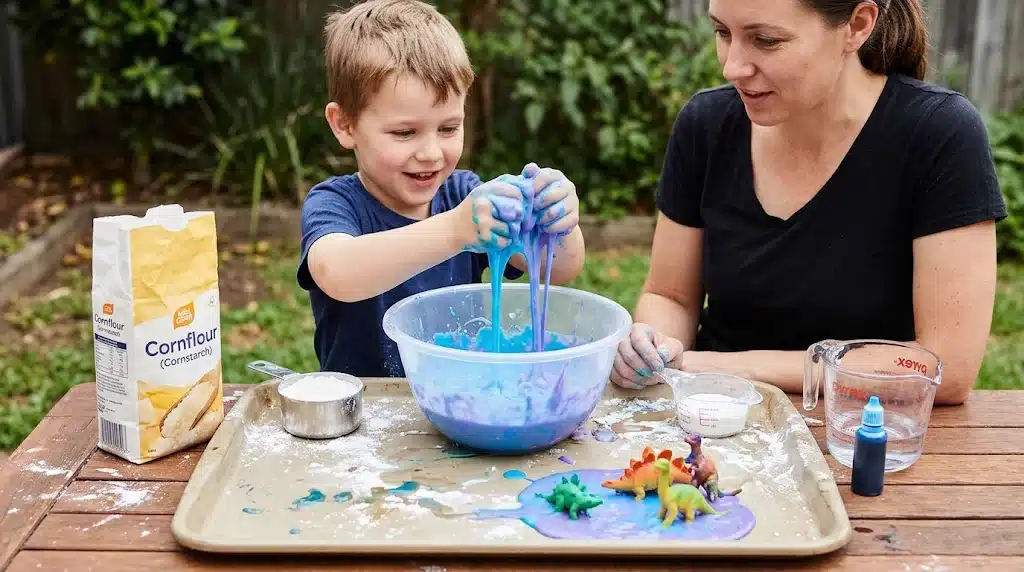
- Squeeze a handful. It should feel hard when you squeeze it and flow when you relax your hand.
- Adjust the consistency. If it is too runny, add more cornstarch. If it is too crumbly, add a teaspoon of water.
- Play! Squeeze it, roll it and let it flow through your fingers.
Every batch comes out a little different, so make small changes and test again.
Can You Make Oobleck Without Cornstarch?
Cornflour gives the best result. Some other starches also work, including potato starch, arrowroot and tapioca starch. The amounts differ, so add water slowly and test as you go.
Plain wheat flour does not work well, and baking soda does not work at all. If a child has a maize allergy, do not use cornflour.
Why Does Oobleck Act Like a Solid and a Liquid?
Cornflour does not dissolve in water. Instead, tiny cornstarch particles float in the water. When you move the oobleck slowly, the particles slide past each other. The liquid flows through your fingers.
When you squeeze or hit it, the pressure pushes the particles together. They jam, and the mixture hardens like a solid. When you stop pressing, the particles move apart again. The liquid flows and your hand sinks in.
Scientists call this shear thickening. Viscosity means how thick a fluid is. Normal fluids, such as water, keep the same viscosity. Oobleck changes viscosity when force is applied, so it is a non-Newtonian fluid.
Why Does Oobleck Matter? What Children Learn
Oobleck is more than a messy bit of fun. It gives children a safe way to meet big science ideas with their own hands.
- States of matter: children see that a material can act like a solid and a liquid. This challenges the idea that every material is only one or the other.
- Predicting and observing: children guess what will happen, test it and describe the result. These are the first steps of scientific thinking.
- Fair testing: changing one thing at a time, such as the amount of water, shows why scientists compare results.
- Everyday science: many fluids around us change when we push on them. Ketchup, toothpaste and some paints are good examples.
- Sensory play: squeezing, pouring and rolling give young children rich sensory play and practice with their hands.
- Talking and vocabulary: words such as solid, liquid, force and pressure come alive when children use them while they play.
For teachers, the activity links to lessons on solids, liquids and gases. For parents, it is a cheap, quick way to turn a rainy afternoon into real science.
Oobleck Science Experiment Ideas for Kids
Ask children to predict what will happen before each test. Then let them try it and explain the difference.
- Roll a ball: roll oobleck between your palms until it forms a ball. Stop rolling and watch the ball melt into a puddle.
- Punch and tap: tap the surface quickly, then push a finger in slowly. Compare the two.
- Squeeze and pour: squeeze a handful, then open your hand and watch it drip.
- Colander test: pour oobleck through a colander. Does it flow faster when you tap it?
- Dinosaur dig: bury toy dinosaurs in the oobleck and let children dig them out. Our dinosaur activities for EYFS have more ideas.
- Coloured oobleck: make three bowls with different colours and compare how they feel.
For a fair test, change one thing at a time. Try more water in one bowl and more cornflour in another. Then compare how each one behaves.
Oobleck Safety and Mess Tips
An adult should supervise the whole activity. Oobleck is messy, so plan the space before you start. It is not food, so children should not eat it. A small taste is unlikely to cause harm, but a lot may upset a tummy.
- Cover the table with a plastic tablecloth and put the bowl on a tray.
- Food colouring can stain, so use old clothes or aprons.
- Keep a damp cloth and a towel nearby for sticky hands.
- Let spills dry, then sweep or vacuum the powder. Cornflour washes out of clothes easily.
- Do not pour thick oobleck down the sink, because it can block pipes.
Most surfaces are easily cleaned once the oobleck dries.
How Long Does Oobleck Last?
Oobleck dries out within a few hours if you leave it in the open. You can store it overnight in a sealed container. Add a little water and stir before you play again.
Use it within a day or two. Throw it away if it smells or you see mould. Put used oobleck in the bin, not down the drain.
Oobleck Activities for Nurseries, Schools and Parties
Oobleck suits nurseries, classrooms and holiday clubs because the ingredients are simple. Try it on a tray for sensory play, or in a tub for small groups. For more ideas, see our children's fun science experiments and science experiments for preschoolers.
If your group enjoys oobleck, explore our states of matter workshop. Children love our science of slime workshop too. For SEN groups, see our sensory slime workshop.
Teachers and nursery staff can read about our nursery and preschool science workshops and primary school workshops. Families can book a science birthday party or try more science experiments for kids at home.
Book a Science Workshop with Wild Science
Ready to book? Call 03301131136, Monday to Friday 9:00 to 16:30 or Saturday 9:00 to 15:00. You can also email [email protected].
Prefer to book online? Fill in our contact form with your date, location and group size. If you want a topic that is not on our website, tell us. We will create a customised session. You can also browse all our science parties and workshops.