

How to Make a Volcano with Baking Soda
A volcano experiment for kids is one of the best ways to see a chemical reaction up close. In 30 minutes, you can make your own erupting volcano with baking soda, vinegar and kitchen items. Children learn about acids, bases and gases while they have fun.
Wild Science runs hands-on science workshops, and this fizzing reaction is a favourite with children. This page gives exact amounts, safety tips, four variations and a simple science explanation to share with kids.
- Time: about 30 minutes, including the build
- Ages: 3 and over, with an adult helping
- Mess level: high, so work on a tray or outdoors
- Skills: following steps, predicting, observing and explaining
What You Need to Make a Volcano
Most of these materials are already in a kitchen cupboard.
For the volcano model:
- A clean, empty plastic water bottle, about 500 ml
- A tray or baking tin to catch the foam
- Play dough or modelling clay, or papier-mâché strips
- Washable paint and a brush (optional)
For the eruption:
- 2 tablespoons of bicarbonate of soda (baking soda)
- 1 tablespoon of washing-up liquid (dish soap)
- 2 tablespoons of warm water
- 100 ml of white vinegar in a plastic cup
- A few drops of red food colouring
- A spoon, a bowl and a plastic tablecloth to protect surfaces
Use bicarbonate of soda, not baking powder. Baking powder gives a much weaker fizz.
How to Make Your Own Volcano Model
- Stand the bottle in the middle of the tray.
- Press play dough around the bottle to build a mountain shape. Leave the neck of the bottle open.
- Create a crater around the opening. Add grooves down the sides for the lava flows.
- Paint the model with washable paint and let it dry. Skip this step if you are short on time.
A plastic cup also works as a quick volcano model for toddlers and younger children. The build is also a great art project, so let children decorate the model.
How to Make a Volcano Erupt with Baking Soda and Vinegar
- Place the volcano on its tray, outdoors or on a plastic tablecloth.
- In a bowl, mix the bicarbonate of soda, washing-up liquid and warm water.
- Pour the mixture into the bottle through the crater.
- Add a few drops of red food colouring to the vinegar in the cup.
- Slowly pour the vinegar into the bottle. Stand back and watch the foam rise.
- Wait for the volcano's eruption to stop, then try again with different amounts.
We add the vinegar last because the eruption then starts where children are looking. Before step five, ask them to predict how high the foam will go.
Why Does a Vinegar Volcano Erupt?
Vinegar contains acetic acid. Bicarbonate of soda, also called sodium bicarbonate, is a base. When they combine, the acetic acid and bicarbonate react and make carbonic acid. Carbonic acid is unstable, so it instantly breaks down into water and carbon dioxide gas.
The gas forms bubbles. In the narrow bottle, the bubbles have little room, so they push upwards and out of the crater. Washing-up liquid holds the gas in the liquid. That makes thick foam that looks like lava.
This is a chemical reaction, because new substances form. The fizzing and foam are the clues.
How Is a Volcano Experiment Different from a Real Volcano?
Real volcanoes work in a different way. Deep underground, rock melts into magma, which is molten rock. When magma reaches the surface, we call it lava. Gas trapped in the magma builds pressure, and that pressure helps drive an eruption.
Our model uses a fizzing reaction instead of heat and pressure, so it is safe to try at home. Real volcanoes around the world, such as Mount Vesuvius, which erupted in 79 AD, are far larger and more dangerous.
Ask children to compare the two. What is the same? What is different?
Volcano Experiment Variations
Once you know how to make a volcano, try one of these ideas.
Lemon Volcano Experiment
Cut a lemon in half and stand it cut side up on a tray. Squash the flesh with a spoon to release the juice. Add a few drops of food colouring and a squirt of washing-up liquid. Sprinkle in bicarbonate of soda and watch it foam. Lemon juice contains citric acid, which replaces the vinegar.
Snow Volcano Experiment
This one suits a cold day. Pack snow around a small cup and leave the top open. Add bicarbonate of soda, washing-up liquid and red food colouring to the cup. Then pour in the vinegar.
Rainbow Volcano Experiment
Put vinegar into three small cups and add a different food colouring to each. Pour them into the volcano one after another for rainbow lava.
Papier-Mâché Volcano
For a longer project, build a papier-mâché volcano over several days. Let it dry fully before the eruption. A bigger model makes a great science fair display.
How to Make a Bigger or Smaller Eruption
Change one thing at a time to see what happens.
- More baking soda: more baking soda with enough vinegar makes more gas. Extra baking soda with too little vinegar stays at the bottom.
- More or less washing-up liquid: more soap makes thicker foam. Without soap, you get fizz but very little foam.
- Warm water: warmer liquids react slightly faster. Use warm water, never hot.
- A narrower opening: a smaller crater usually pushes the foam higher.
Safety and Mess Tips for an Erupting Volcano
An adult should supervise the whole experiment. Younger children need help with pouring. It is a messy experiment, so stand back when you erupt your own volcano.
- Keep vinegar and the mixture away from eyes. If it splashes, rinse with clean water.
- Older kids can wear safety glasses for extra protection.
- Never put a lid or cork on the bottle. Trapped gas can build up pressure.
- Do not taste or drink anything in the experiment.
- Food colouring and paint can stain, so use washable paint and old clothes.
- Wash hands afterwards. Rinse leftovers down the sink with plenty of water.
Teacher Tips and Science Fair Ideas
Teacher Tips for a Class Volcano Experiment
- Work in groups of four, with one tray for each group.
- Pre-measure the ingredients into labelled cups before the lesson.
- Demonstrate once, then let each group repeat the experiment.
- Give every child a job: pourer, timer, recorder or observer.
- Link the experiment to lessons on states of matter, rocks and chemical changes.
Volcano Science Fair Ideas
Turn the experiment into a fair test. Change one thing and measure the result.
- Measure the foam height with a ruler after each eruption.
- Test three different amounts of vinegar, and keep everything else the same.
- Compare a vinegar volcano with a lemon volcano.
- Record the results in a table and repeat each test three times.
- Make a poster with the steps, your results and the science explanation.
More Fun Science Experiments for Kids to Try
If your child loves this one, explore our children's fun science experiments for more ideas. Our science experiments for kids at home use everyday items.
For younger children, try these science experiments for preschoolers. You can also try the elephant toothpaste experiment in our top 10 engaging scientific experiments. More easy science experiments for kids are on our blog.
Planning a themed celebration? See our science birthday party ideas for kids. Our British Science Week activities are also popular with schools.
Bring a Volcano Experiment to Your School or Party
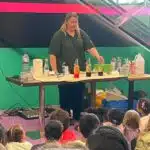
Wild Science brings expert-led science workshops to schools, nurseries, clubs and homes. Our Science Experiment Mix workshop includes a bicarbonate of soda and vinegar eruption.
Teachers can explore our materials workshop for schools and our primary school workshops. Younger groups enjoy our nursery and preschool visits.
Families can book a science birthday party or a home visit. We also run sessions for holiday and after-school clubs and scout groups. Read what to expect at a science event before you book.
Book a Science Workshop with Wild Science
Ready to book? Call 03301131136, Monday to Friday 9:00 to 16:30 or Saturday 9:00 to 15:00. You can also email [email protected].
Prefer to book online? Fill in our contact form with your date, location and group size. You can also browse all our science parties and workshops to find the right fit.