

More about Science of Flight Workshop
Science of Flight Workshop for Schools and After-School Clubs
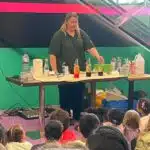
The Science of Flight Workshop is a hands-on, curriculum-linked school science workshop about how things fly. Children explore the four forces of flight, build paper gliders and test how wing shape changes a flight. Wild Science brings the workshop to your school, club or event.
Call 03301131136 or request a quote with your date, location and group size. We will check availability and plan the session with you.
- Ages: suits all ages, and we adapt the science to your group
- Length: 45 minutes to 1 hour, or a full day of six 1-hour sessions
- Style: hands-on experiments, building activities and guided demonstrations
- Who can join: children, teachers and adults, so families can play too
- Where: schools, clubs and community events across England, Scotland and Wales
- Safety: DBS-checked staff and a risk assessment with every booking
What Will Children Explore in the Science of Flight Workshop?
Every session is led by a Wild Science presenter. Children investigate the core ideas of flight science, including:
- How air pressure and airflow create lift
- The roles of thrust, drag, gravity and weight
- How wing shape and angle affect flight
- Why birds, planes and rockets move in different ways
What Hands-On Experiments Are Included in the Workshop?
This workshop is all about learning by doing. Children use everyday materials to build and test their own flyers. They will:
- Build and test paper gliders
- Make spinning flyers
- Try air-powered models
- Change shapes, angles and speeds to see what happens
Children make predictions, test their ideas and learn from trial and error. Small changes can make a big difference to how something flies. No prior knowledge is needed, just a sense of wonder.
How to Book a Science of Flight Workshop
Booking a hands-on science workshop takes a few minutes.
- Call 03301131136 or fill in our contact form with your date, location, age group and group size.
- We confirm availability and agree the session length with you.
- Our presenter brings the workshop to your venue.
Why Should Schools Choose Our Science of Flight Workshop?
- An interactive learning experience for every age
- Builds understanding of the forces that make flight possible
- Encourages curiosity, predictions and problem solving
- Introduces simple physics and engineering ideas in a fun way
- Gives every child a chance to build and test their own flyer
The workshop fits Year 5 forces in the England national curriculum. Pupils explore gravity and air resistance, which is also called drag. Please check it against your own scheme of work.
Our staff are DBS checked, and we hold public liability insurance of at least £5 million. We also carry out a risk assessment with every booking, and we use child-safe materials.
Want to know why schools book science days? Read how science workshops inspire young minds and how they build creativity and innovation in schools. Our sessions also support neurodiverse learners.
Science Workshops for Primary, Secondary and SEN Groups
Teachers can find out more about our primary school workshops, infant and junior school visits and secondary school sessions. For younger children, see our nursery and preschool workshops. For children with additional needs, see our SEN workshops.
We also run science workshops for schools on many other topics. You can browse every workshop on our experiments page. Looking for another physics topic? Try our science of forces and magnets workshop or our science of sound workshop.
Our blog on new science workshops on sound and flight explains how the topics fit together. Planning for March? See our ideas for British Science Week.
Science of Flight Workshop Length, Ages and Locations
Our Science of Flight Workshop suits children of all ages. Some ideas can be tricky for younger children. However, we can adapt the workshop to suit any age group.
We suggest sessions of 45 minutes to 1 hour. We are also happy to extend the time if you want to explore the topic in more depth. A full-day option has six 1-hour sessions, so it suits pupils of all ages.
We bring mobile Science of Flight workshops to schools and community events across England, Scotland and Wales. Tell us your postcode when you enquire, and we will confirm we can reach you.
Adults are welcome to join in. We encourage parents and teachers to have fun alongside the children and to help them out.
Parents planning a celebration can book a workshop too. Our science birthday parties bring the same hands-on fun to your home or venue. We also offer home visits and sessions for scout groups and holiday and after-school clubs.
What Is the Science of Flight?
The science of flight explains how objects stay in the air. It covers birds, airplanes, helicopters, balloons and rockets. Airplane is the American spelling of aeroplane, and both words mean the same thing.
Flight is about air and forces. Air is a mixture of gases, and it has weight. Moving air pushes and pulls on everything that flies. In the Science of Flight Workshop, children test these ideas with their own hands.
Aerospace engineering uses the same ideas. Engineers study how air moves around a wing. Then they design airplanes that fly safely and use less fuel. Aerospace engineering is a great example of science in real life.
How Do Airplanes Fly? The Four Forces of Flight
Four forces act on every airplane in flight. They are lift, weight, thrust and drag. In the 19th century, an English engineer named George Cayley described these four forces of flight. These aerodynamic forces work in pairs. Thrust pushes against drag, and lift works against weight.
Lift and Weight
Lift is an upward force that holds an airplane in the sky. This lift force acts against gravity. Weight is a downward force, and it acts through the centre of gravity of the airplane. To fly, an airplane needs as much lift as its weight, or more.
Thrust and Drag
Thrust is the forward force that moves the airplane through the air. It gives the airplane its forward movement. Engines or propellers make thrust by pushing air backwards. Thrust keeps the airplane moving forward.
Drag opposes the aircraft's motion. It acts in the opposite direction to thrust and slows the airplane down. Smooth, streamlined shapes cut drag, so designers shape airplanes with care.
In level flight, the four forces balance. The airplane then flies in a straight line at a steady speed. If thrust is greater than drag, the airplane speeds up. If lift is greater than weight, the airplane climbs.
How Do Airplane Wings Create Lift?
Airplane wings have a curved shape called an airfoil. This shape controls how air flows around the wing. Lift also grows with speed. The faster the wing moves through the air, the more lift it makes.
Air Pressure Around a Wing
As air flows over the curved top of the wing, it moves faster. Faster air has lower pressure. The pressure on the top of the wing is lower than the pressure underneath. This pressure difference creates an upward force.
Bernoulli's Principle
Bernoulli's principle says that fast-moving air has lower pressure than slow-moving air. This idea helps explain why air pressure changes around a wing. A wing also pushes air downwards as it moves. The air then pushes the wing up. Both ideas help to explain lift.
Angle of Attack
The angle of attack is the angle between the wing and the air that meets it. A small tilt upwards makes more lift. A very steep tilt can make the airflow break up, and the wing then loses lift. Pilots and engineers always think about the angle of attack.
How Do Pilots Control an Airplane?
A pilot changes direction by moving flaps on the wings and tail. Three movements matter: roll, pitch and yaw.
- Roll: the pilot lowers the aileron on one wing and raises it on the other. The wing with the lowered aileron rises. The wing with the raised aileron drops.
- Pitch: elevators on the tail raise or lower the airplane's nose. Raising the nose makes the airplane climb. Lowering it makes the airplane descend.
- Yaw: the rudder turns the nose left or right. The airplane's nose points in the same direction as the rudder. Turn the rudder to the left, and the airplane moves left.
The pilot uses the rudder and the ailerons together to make a turn. Children can copy these movements with their arms. Hold your arms out like wings, then tilt one side down. You have just made a roll.
How Does a Plane Take Off and Land?
A plane sits on the ground until its engines give it enough power. The plane then speeds along the runway. The faster it goes, the more lift its wings make. At the right speed, lift beats weight, and the aircraft leaves the ground.
In the air, the pilot controls the speed and the direction of the plane. Air gets thinner as an airplane climbs. For example, the air high above the ground has fewer air particles, so wings have less air to make lift.
To land, the pilot slows the plane and lowers it gently onto the runway. The pilot reduces engine power to slow down. Large aircraft burn fuel to make power, and they carry passengers across the world.
Flight in Nature and Beyond Airplanes
Many living things and machines fly in different ways.
- Birds: a bird's wing has a similar shape to an airplane wing. Birds flap to make thrust and lift.
- Helicopters: the spinning blades act like wings. Their movement makes lift, so a helicopter can rise straight up.
- Hot air balloons: hot air is lighter than cool air. A hot air balloon rises into the sky. It comes back down when the air cools.
- Gliders: a glider flies without an engine. It uses gravity and moving air to stay up.
- Rockets: a rocket pushes hot gas out of its engine. The gas goes one way, and the rocket goes the other.
Many birds also travel long distances each year. Read our blog on autumn bird migration in the UK to learn more.
From the Wright Brothers to Aerospace Engineering
People dreamed of flying for hundreds of years. The Montgolfier brothers made the first hot air balloon flight with people on board in 1783. Otto Lilienthal then made many successful glider flights during the 1890s.
The Wright brothers made the first powered, controlled and sustained flight in an airplane in 1903. Their success came from careful testing. They tried many wing shapes and learned from each result. These pioneers of aviation still inspire engineers today.
Today, aerospace engineering builds on that work. Engineers design airplanes, helicopters and spacecraft. Children who enjoy building and testing may enjoy STEM careers in aviation one day.
Easy Flight Experiments to Try at Home
You can explore flight at home with a few simple items. Ask children to predict what will happen before each test.
- Paper airplane test: fold two paper airplanes. Bend the back edges of one wing up on the first airplane. Throw both and compare. Change one thing at a time.
- Lift with a paper strip: hold a thin strip of paper under your bottom lip. Blow gently across the top. The strip rises as the moving air passes over it.
- Balloon thrust: blow up a balloon and let it go. The air rushes out one way, and the balloon shoots the other way.
- Parachute drag: tie string to the corners of a tissue and add a small weight. Drop it and time the fall. Then drop the weight alone. The parachute falls slower because of drag.
For more ideas, see our science experiments for kids at home and easy science experiments for children. You can also try children's fun science experiments. Younger children may enjoy easy science experiments for kindergarten. Older pupils can try our top 10 engaging scientific experiments or our science experiments for high school.
Free Science of Flight Activity Sheet
You can also download our free science of flight activity sheet to keep the learning going back in class.
Book the Science of Flight Workshop
Ready to book? Call 03301131136, Monday to Friday 9:00 to 16:30 or Saturday 9:00 to 15:00. You can also email [email protected].
Prefer to book online? Fill in our contact form with your date, location and group size. If you want a topic that is not on our website, tell us. We will create a customised session.