



If your house suddenly feels busier with eight-legged visitors, you’re not imagining it. Every autumn, UK homes see a genuine rise in spider sightings. Pest sites call it “spider season,” and it makes the news every year on a fairly predictable schedule. In fact, spider season UK is a term many now use to describe this annual autumn increase. There’s no need to fear it. At Wild Science, we spend our days introducing children and families to real animals, including plenty of creepy crawlies. So we wanted to explain what’s actually going on. There’s no need to panic when a large spider turns up in the bath. This guide is for UK homeowners and families curious about the seasonal increase in spiders.
What Is Spider Season in the UK?
Spider season is the UK’s yearly stretch of increased spider activity and sightings. Spider season in the UK typically runs from late August through October, with activity peaking in September when male spiders search for mates. It overlaps closely with the spider mating season, and most sources agree it begins in early September and ends in mid-October. It lines up with the end of summer, when many common house spiders reach adulthood. That timing, more than anything else, is why autumn feels like peak spider season.
Why You're Seeing More Large Spiders in UK Homes This Autumn
There are three real reasons behind the seasonal surge, and none of them mean spiders are breeding out of control.
They've finally grown to full size
- Most UK house spiders hatch in spring and spend the whole summer growing. By September, they’ve reached their adult size, which is exactly when they become impossible to miss.
Autumn is mating season
- Male spiders leave their webs and go wandering in search of a mate. That means more spiders out in the open, including inside houses, rather than tucked away in a corner. It’s also how so many end up entering homes in the first place.
Cooling weather pushes them indoors
- As temperatures drop, spiders look for warmth, shelter, and a reliable supply of prey. Open windows and doors in early autumn make it easy for them to wander in.
The Natural History Museum puts it plainly: spiders “aren’t bigger, and there aren't really more of them.” We simply notice the ones that are already there. Fewer homes stay sealed and heated like modern houses. So what used to be a normal, barely-noticed autumn habit now feels like an invasion.
Meet the House Spiders Behind Spider Season
A handful of species are behind almost every “there’s a huge spider in my house” moment. Here are the most common urban spiders you’re likely to meet during spider season. We’ve also included a couple of less common urban spiders worth knowing.
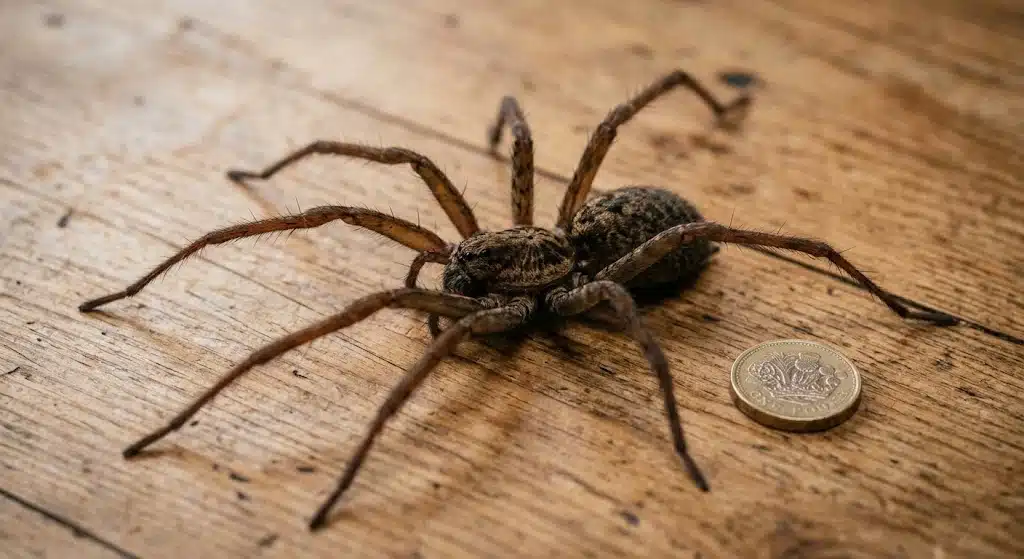
Giant house spiders (genus Tegenaria and Eratigena) are the classic autumn scare. Males can have a leg span of up to 120 millimetres. They’re usually brown and hairy, with faint stripes on the body. They build the messy, funnel-shaped webs you’ll spot in corners and behind furniture.
Garden spiders (Araneus diadematus) are the ones weaving the large, symmetrical webs across hedges and doorways. Females are nearly twice the size of males, and a single web can measure up to 40 centimetres across. They’re active from April to November, feeding on flies, wasps, and other flying insects. Autumn is when their webs are at their biggest and most visible.
Noble false widow spiders (Steatoda nobilis) get the most nervous headlines. In fact, they’ve lived in Britain for well over a century. They typically reach about half an inch in length. They’re the one common UK species that does possess venom strong enough to feel. Even so, if they potentially bite, the effect is mild, so serious problems are very unlikely.
The UK's Own Purseweb Spiders
Not every UK spider fits the “creeps in through the window” story. The purseweb spider (Atypus affinis) is one of Britain’s most overlooked residents, and it happens to be related to tarantulas. Both belong to the same group of straight-jawed, heavy-bodied spiders known as mygalomorphs.
Purseweb spiders build a sock-shaped silken tube, roughly 8 centimetres long, camouflaged with dust and grit, hence its name. British arachnologists have nicknamed the whole structure “life in a dirty sock.” Once you’ve seen one, it’s easy to see why. Most of it sits below ground in a burrow that can extend a further 50 centimetres down. Only a small part sits above the soil surface. When an insect wanders across the tube, the spider bites straight through the silk from inside. You’ll find them on rough, sandy or chalky grassland across southern England. Purseweb spider bites in people are essentially unheard of. The species spends nearly its entire life underground, so it rarely encounters humans at all.
Curious about Britain’s stranger arachnids? Our tarantula guide covers the purseweb spider’s much larger, more famous relatives.
Are UK Spiders Dangerous to People?
For almost every UK spider, the honest answer is no. Nearly all other spiders in this country can’t bite humans. Their jaws don’t open wide enough, and their fangs aren’t strong enough to get through our skin.
The UK’s spider population is harmless to humans and non-aggressive. Most bites from UK spiders are extremely rare and mild. Most UK spiders are beneficial as they act as natural pest control.
The noble false widow is the main exception. Even its bites usually cause nothing worse than mild, short-lived discomfort, similar to a wasp sting. Giant house spiders can bite if they’re picked up and handled, but again, the effect is minor. Serious reactions to any UK spider bite are rare.
Spiders Are Free Pest Control
Before reaching for a jar and a piece of card, it’s worth remembering what spiders actually do for your home. They’re a vital part of the UK’s natural pest control system. They help control pests like flies, mosquitoes, and ants without you lifting a finger. Please don’t kill them: a spider left alone will simply keep working.
An average house already shelters around 40 spiders tucked into cracks and crevices, and older houses can hold far more. Most of them will never be seen, and the ones that are seen are usually just passing through. You can also gently move them outside with a glass and a piece of paper. Either way, that keeps the free pest control working in your favour.
Turn This Autumn's Spiders Into a Learning Moment
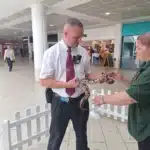
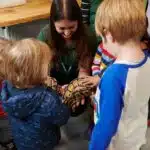
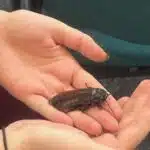
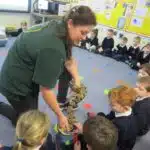
Spider season is a good reminder that most “scary” wildlife is harmless. The spiders sharing our homes and gardens are actually doing us a favour. Has your family’s curiosity about spiders, tarantulas, and other mini beasts been sparked? Our mini beasts sessions and Mini-Beasts invertebrate workshop let children get hands-on with real invertebrates. That includes a close look at a tarantula, in a safe, supervised setting.
Explore the full range of animal encounters on our zoo page.
Our animal visit programs for schools across the UK and what to expect from animal school visits pages explain how we bring these experiences into the classroom. You can also book a UK-wide animal encounter experience or browse our full range of science and animal events.
Get in touch with our team to bring the science of spiders to your school, party or event, whether you’re interested in animal school visits in Glasgow, animal school visits in Leeds, animal school visits around Glasgow for all ages, animal parties in Glasgow, or a dedicated reptile handling experience in the UK. We work with plenty of other animals too.